Friday, November 13, 2015

Remembrance

The wind is strong today, determined to wipe the last stubborn leaves off the trees. When you drive in the hollows, the trees are protected and colorful. But here I’m in the open and glad for the evergreens around the yard that stand up to the wind and ward off the grey stooping ceiling. Sentinels in spiky uniforms.

Today I went in for radiation two hours early, forgetting to adjust my calendar for my day off yesterday—Remembrance of the 11th hour on the 11th day of the 11th month. Everyone was wearing red poppies. For soldiers left behind in Flanders.

We remember soldiers of all kinds. I have just finished my book, and the last chapter is about  women “soldiers.” (I avoid military imagery when talking about Christians service, but sometimes we forget about the people who have been killed in “battle” for their faith. As evangelicals we don’t have a moment of silence for our martyrs, or any remembrance at all that I know of.) My reading highlighted the women in the roll call at the end of Romans: Phoebe, Prisca, Mary, Junia, Tryphaena and Trphosa, Persis, the mother of Rufus, Julia, the sister of Nereus. I’ll tell you what the book says about them.

Phoebe heads the list. She is a deacon (not a deaconess; apparently there is no such thing in the Bible) from the church of Cenchrea, a port near Corinth, from where Paul was most likely writing, and from the way she is commended to the Roman Christians, it’s possible she was the carrier of the letter and read it aloud to them, as would have been the custom, the first interpreter of its Pauline tones. Some translations call her a helper or servant, but when the same word is applied to Paul, it becomes “minister.” The deacons we know about in Acts were certainly gifted ministers of the gospel, leaders of the early church, and probably Phoebe was, too, because she’s also called a benefactor, one who “stands before” others to preside and/or aid, and when Paul uses this word elsewhere, it means elders or leaders.

Prisca (Aquila’s wife) we know about from the book of Acts, a tent-maker, a hospitality giver. Her name goes before that of her husband, and she’s known for gently, discreetly mentoring Apollos. Paul talks about her as a fellow missionary, doing the work of God to proclaim the gospel, and he claims that “all the churches of the Gentiles” give thanks for her ministry with Aquila.

Junia, probably married to Andronicus, is counted as “prominent among the apostles.” A female apostle, and an outstanding one! For a thousand years no one questioned this. But Martin Luther decided that this wasn’t possible, so he changed her name to Junias, a male, when he wrote the German translation of the Bible. Sex-change-by-translation, someone called it. Someone else went back to check the records. The name Junias simply doesn’t exist. There are lots of “Junia’s” in ancient Roman inscriptions, and they are women, every one. So says my book.

Mary, Trypheaena, Tryphosa, Persis. These women, like the others, were known for their “hard work,” which for Paul means the hard work of spreading the gospel and ministering to the churches. The last three may have been slaves, and the two Try’s might have been sisters (often named similarly), even sex workers, because their names meant “dainty” and “luscious.” Whatever they were before meeting Jesus, Paul knew them as fellow workers, soldiering on beside him through thick and thin to bring God to people. 

Then there is one who became like a mother to Paul, and Julia who may be the mother of Nereus’ sister, bringing her up to serve just like Mom. It’s hard to tell, since Paul doesn’t mention the blood lines, marriages or social status of the women. No. They are co-workers, working hard. If you've done research on them and know other things about them, let me know. Burning question: if Paul welcomed women as leaders in the church, as it appears he did, why didn't he make this obvious? Why did God allow the ambiguity that's caused so much conflict and unheld babies?
Whatever their role, I'm glad Paul included these women in his roll call of honor. I'm glad to be reminded of them.

Thursday, November 12, 2015

Tyrannical texts

A friend of mine, a Moravian minister, sent me a book that I’m just finishing now. It’s about those texts that get to us, that bother us and make us mad. They are also the ones some people use to put other people in their place. The ones that don’t make sense and require a lot of research and contextualizing. The ones that Christians fight over and and take sides over and stop fellowshipping over. The book calls these the tyrannical texts.  I mentioned the one that made my friend Kathy mad. Under the Old Testament, if a woman gave birth to a boy, she was unclean for seven days, but if she gave birth to a girl, she was unclean for two weeks. She needed 33 days to be purified after her son’s birth and double that to be purified after her daughter’s. What’s with that? The Law is full of such discrimination against women.

slavery memorial: Tanzania
Yes. I know. The Old Testament does not have the weight of the New because Jesus fulfilled the Law. We aren’t under the Law now. We read the Old Testament through the lens of Jesus and disregard those adamant requirements for animal sacrifices and feast days and untrimmed beards. That is good Anabaptist thinking—the rejection of a flat cannon. But even a hundred and fifty years ago, the Old Testament and New were still read with equal weight. And then there are those troubling  New Testament commands like “Slaves, obey your masters.” Today we know that although Paul may have had a point then, to use this as justification for slavery today would be unthinkable. (Why didn’t he say this?) Yet this verse was used by Christian pastors all across the South to justify slavery from the pulpit. Here is how one Southern newspaper summarized the Christian position on slavery in 1820:

“The Bible, comprehending the old and new Testaments, contains the unerring decisions of the word of God…These decisions are of equal authority in both testaments…God is infinitely just and wise in all his decisions…so it is culpably audacious in us to question…Whoever believes the word of God…must believe in the absolute rectitude of slave-holding.”

Preacher who pushed for Georgia to be a slave state
 If you were a white minister in the south, this is what you preached. It’s horrible. But look at the language. Does some of it sound familiar? It’s what the abuse of spiritual power sounds like. I know you’re wondering where I’m going with this. Am I gunning for people to interpret Scripture however they want? Is there no solid ground? (Short answer: No. Yes.)
 
Here’s the tyrranical text I am researching now: 1 Corinthians 14:34. Look it up if you wish. I’m not going to write about it. But I can assure you that whatever interpretation I choose, someone will disagree. Someone might even question my integrity or my commitment to the authority of Scripture, and that would be unfair. And dangerous. You see, it’s because no one could talk to those southern ministers about their fierce, public defense of slavery that this demonic institution could thrive in the South. No one could question it or disagree, because then you’d be disagreeing with Scripture, and even with God, Himself. And this is not what we want to do. But we do want to question human beings, human leaders, even pastors, who are not God, and who can get things wrong. I think as many of them have gotten things wrong about women as got things wrong about slaves a century ago. On my last trip to Mexico a friend told me that her church forbids her husband from holding their baby: it would be demeaning to him because holding babies was the wife’s job. It made my blood boil.

Durer
Do you know the first thing Jesus ever did in the Temple of God? He asked questions for three days. Do you know why Jacob was given a new name and a blessing? He wrestled with God.

Moses was inspired when he said all those things that today make women look like inferior beings, and Paul was inspired when he wrote, “Women should be silent,” and “Slaves, obey your masters.” For some reason God wanted those words in our Scripture. It’s taken us thousands of years to learn that those words aren’t meant to justify slavery or sideline women in our churches today. What else have we been preaching for thousands of years that isn’t right today? Do we think that we are the first ones in history to get the Bible 100% correct? Are we perfect in knowledge, like God, Himself? Or is there room to pull out those tyrannical texts and argue, and pray, and study, and listen, and wrestle with one another and with God?


Tuesday, November 10, 2015

Questions

I am married to someone who asks a lot of questions. When Janey’s family and the two of us were walking the Bruce Trail, Robert was testing Dawnelle’s reflexes by tossing something to her, a pocket knife, I think. She squawked, and Dan asked if she’d prefer that he start tossing her questions instead. She said she’d stick to the (closed) knife throwing. Smart girl. Because questions can be just as hard to parry. “Just look at Socrates,” I said. “Who’s that?” She asked. (Teachers live for such questions).

trireme: love the eye
I told her Socrates was a fat, ugly old man, who walked around Athens asking awkward questions and getting himself in trouble because (supposedly) his questions provoked the youth of Athens to question the existence of the gods. He was called the Gadfly of Athens. Nice. He also started questioning the judgment of the authorities of Athens, who he thought were running their war with Sparta the wrong way because they kept eliminating any ship captains who lost sea battles. They were getting to the place where they finally had no competent captains left to put on those sleek triremes. (They lost the war; no surprise). But Socrates’ criticism was considered anti-patriotic, and he was handed a nice hemlock soda. Robert asked me if I thought he looked like Socrates, and that’s why I was telling the story. I thought it best not to answer. I’ve learned some questions are rhetorical.
To balance out the picture we have to remember that the Snake asked Eve a question, too, and brought down the entire human race on her answer. So not all questions are healthy or innocent.  But if you notice, God’s solution wasn’t to shut down the question even when we got the answer terribly wrong.

My friend Kathy gave a testimony this Sunday about how God tolerated her questions. She asked Him why He had included that passage in the Bible that said that women were unclean after childbirth (she has eight kids). She told Him she was angry about what that sounded like, and she shut down the conversation with Him over it for a while. She said that He just waited for her patiently, and eventually He helped her understand Him better, and now they are closer than ever. There were tears in her voice as she told her story. She said God isn’t ever shocked at our questions.  He doesn’t mind what path we take to learn as long as we get there.

I found this passage in one of Paul’s letters (my paraphrase): “When you meet together, one will sing, another will teach, another will preach, one will speak in tongues, and another will interpret…Let two or three people preach, and let the others evaluate what has been said.” It even says that when a person listening to the sermon gets an insight from God, the first speaker should sit down. I can’t even imagine this much participation and accountability in the way we normally do church. And Paul wasn’t even addressing leaders here. He was addressing the whole church. I think he expected a lot of give and take. I don’t think he minded questions.

beware
A teacher friend of mine walked into my classroom for the first time. “I see you use the socratic method for teaching,” she said. And yes, I do. I use a lot of questions to get kids thinking about literature and life. But how in the world did she know that? “Your seating arrangement,” she said. “You’ve seated your kids around circular tables to make it easier for them to see each other and talk to each other and ask questions.” Granted, this is risky; it can bring chaos into the classroom. Paul discovered this. Like me in my classroom, Paul had to establish order, telling people to take turns when they spoke. Socrates ended up paying for his questions with his life. So did God, actually, before he got death (the ultimate chaos) under control. But they all decided that questions were worth the risk. Not that I see a hemlock soda in anyone’s future here. But  sometimes when you’re on the wrong end of the questioning, it gets tempting.


non-poisonous hemlock tree

Monday, November 9, 2015

Sommelier

The color overhead has moved to beneath our feet now, a wave of yellows, oranges and browns tumbled over by the wind as the tide shifts to winter. Fall is quick. It is a verb, a golden movement from up to down in a slow, silent spiral. We take a walk on the Bruce Trail in two spots, one along Rockway Falls, and one next to Janey’s house with her family. Dawnelle’s take on the look is “Dead, dead, dead.” Robert’s is, “Look at all that firewood.”  As for me, I’m just glad to be out walking in this carpet of leaves while it is still warm enough to stay outside this long. Robert keeps wanting to turn back because he knows better than I do how quickly I tire, but I want to keep going. It’s good medicine being out here.

The Bruce Trail runs all along the Escarpment (the cliff down which Niagara Falls) and is named after an earl. It is the longest and oldest marked hiking trail in Canada, and travels through woods,  past waterfalls, over roads, and along people’s lawns and corn fields, a 900 km kaleidoscope. We admire the details: a stark white mushroom on the bottom of a tree trunk, a pine burl, a shimmering pool. What I think about is this: it’s not just humans who use love languages. You know the five—giving gifts, saying affirming words, showing affection, serving, spending quality time. I am fortunate to have a husband skilled in all of them. But God has his five love languages, too.

Sight. I think of the ways He delights us with contrasts. Among the brown leaves starting to show their skeletons, there is one bright yellow leaf still whole. The white mushroom against the brown bark draws my eye. Robert says his mom would collect these tough woody creatures and paint their back with scenery. The smoothness of the pool contrasts with the tumbled leaves and bare, tangled branches between us.

Sound. The dry leaves rustle as the miniature waterfall murmurs steadily in the background, soothing. It too is a child of the fall, its water making a shimmering curtain down over the rocks, passing on that hurricane water we had last week.

Feel. The cold rocks are covered with brown crunchy leaves and a fur of bright green moss. Choose the texture you like, and you’ll find it somewhere here. The contrast is refreshing. Everything God makes invites you to explore further. Ok, except scorpions. And even those, someone like my student Ember would delight in studying.

Smell. Look. A baby evergreen coming up among all these adult deciduous trees. Bright green against all the brown. I think of Christmas trees just hauled in from fields, bringing their smell inside with them. Did you know that smell is the only sense directly connected to your long term memory? How many Christmas trees did you just remember? It’s the only sense that gets more sensitive with age. The best taste testers are old.


Taste. I am not eating anything out here on the Bruce Trail (I wait to pick an apple fallen off the tree in Janey’s front yard), but other creatures are busy eating. One trunk looks like it has become a feast, and all around me the decay makes it possible for spring to come again. Death into life, a lesson of redemption. I eat an innocent apple fallen from a tree in the garden, and I know, in contrast to the imagery, that it is a gift, one of God’s love languages to me. Remember the song, "He fills up my senses?" God fills my senses with good things; my youth is renewed like the eagles. I am a sommelier of God’s goodness, ever more experienced.

Friday, November 6, 2015

Room

Usually I get in to Linac3 right away (don’t ask; I don’t know either. On my first visit, when I asked where the radiation lab was, the nurse said, “It’s there on your paper.” Uh huh. Wait. I just realized what Linac means: Dianne told me the other day that the machine is called a linear accelerator—lin ac—If that’s any help when you’re looking for a radiation room). Today they were running behind, and I was supposed to wait 40 minutes, but Amanda in Linac1 said she could fit me in. Because I’m quick. In and out in fifteen minutes.

I notice the differences in the room right away. They stand out in this solidly white room with its white bed under a white sheet under a white machine waiting to swallow me. On this ceiling, instead of giant dew drops on tree branches against a blue background, they’ve bolted giant hosta leaves against a purple background. Not that I know they are hosta leaves. When they are 200 times too big, it’s hard to recognize them, but Amanda has been in this room a long time, and she’s figured out what they are. She says that makes this the Purple Room. Next door, the Yellow Room has falling leaves. She says that the bosses switch things up every so often (think about that phrase for a bit. Every…so…often? TESL students must be shaking their heads). They change the technologists around to new rooms and partners to break the monotony.

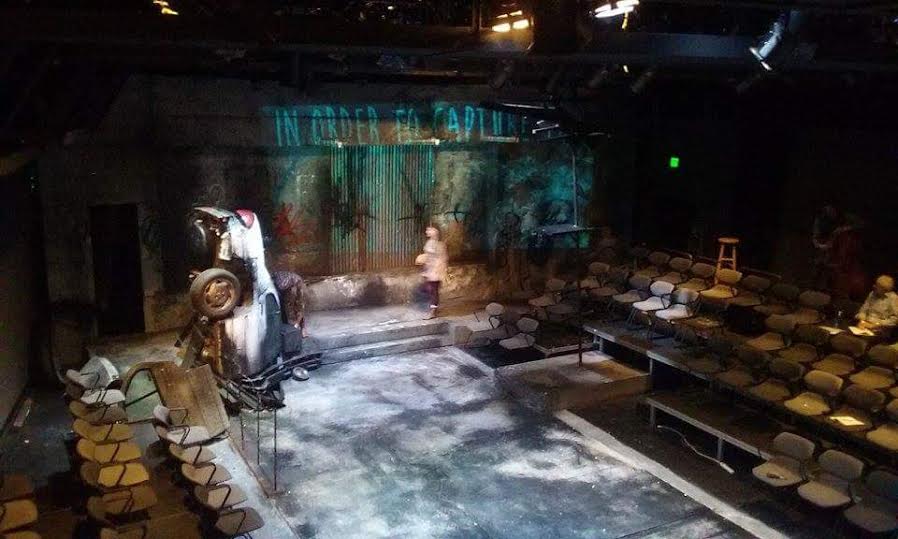
When Elai was in high school, she wrote a research paper on a possible career path that I  had wisely picked out for her. It was precisely this job, a technologist working with death rays or sound waves that travel ultra-ly through your tissues. It’s a great job. Good pay. You get to work in one white, windowless room for eight hours a day, helping very ill people in and out of a machine. “Right,” she said. “I get to look at what is hurting and killing people all day. In a room with no air. No thanks!” So much for my planning my daughter’s career path. She’s now a drama major at Wheaton, managing lights for a play called Caucasian Chalk Circle with half a car sticking up out of the stage. If I weren’t visiting Linac 1, 2, or 3, I could go see it with her. Sigh. The life of a starving artist, my dear. But so much more FUN!

But I tell you I am thankful for Dianne and Rob and Derek and Amanda who attend me, calling out those numbers, shifting, measuring, adjusting, syncing me to life. As they prep me, they say in their young voices, “Excellent. Perfect. Very good. I agree.” I feel part of a job well done. You can find satisfaction in any room. And compassion. And hosta leaves.

Really. Take Room. I haven’t seen the movie yet. It’s out this year. If you see it before I do, tell me what you think. The book was astonishing. It’s about Jack, born and growing up in one 10’ x 10’ room until he’s five because his mother is a captive there. To Jack, the room is an entire world because his mother makes it one, for love. “Good morning, Room,” he says. “Good morning, Lamp. Good morning, Sink.”

Hamlet, with such a different mother, cries out, “O God, I could be bounded in a nutshell and count myself a king of infinite space, were it not that I have bad dreams.” Do you know, it’s up to us to make the room livable? To call out, “Excellent?” To make a room a fairy tale with Sink and Brush for characters? To plant the hosta—on the ceiling if we have to?


Paul says, “I have learned to be content.”  God’s second greatest gift. After what makes it possible. Love. Am I ready for such a lesson?

Thursday, November 5, 2015

Familiar

I leave in another hour for my radiation treatment and a 30 second consultation with the radiologist, “No skin reaction? Great. See you next week.” or "It's just boring now, isn't it." He barely gets in the door. I wonder how a 30 second visit gets billed. Maybe it’s by the word. Fifty bucks a word would be about right. It’s clockwork now, no drama, no fuss. I don’t even have to register at the reception desk. I scan a bar code I’ve been given on a piece of paper, walk on back, change into a gown and sit down. I notice some of us get to stay in street clothes, and some of us have to wear patient uniforms, I mean gowns.  (I wonder if there were any women on the committee that designed them. They are so fashionable. And you have to remember which parts of you are covered and which aren’t, because it’s not obvious.) You don’t really notice the gowns so much when everyone is in uniform, the staff and the patients. But in mixed company, when half of the people in the waiting room look normal and you look like a pale blue blob wearing jeans and boots, you remember. But I am so used to it all now that when I lay under the machine and wait for the familiar series of beeps and buzzes, I almost fall asleep, and when the technicians come back in, I’m disoriented and forget to wait until they lower the bed, and I clunk my head against the machine. They apologize.

How quickly we get used to things. I have trains passing through my backyard every day, and I don’t hear them anymore. I remember when we lived in Ometepec, a group came down from North Carolina to visit us. They slept on the floor of our living room, right next to the street, under openings in the concrete to let in air…as well as the barking of the dogs that protected the street throughout the night. You know how they are. By day the just laze around, but by night the are filled with bravery. Glen couldn’t sleep with all that racket, so he opened the door and threw rocks at the dogs, and off they scurried (don't worry: you don’t have to hit Mexican dogs to get the message across. All you have to do is look like you are picking up a rock and winding up to throw, and that does the trick). But they’d always come back because they were just doing their job, protecting the street at night, and they had nowhere else to go. In the wee hours, Glen gave up and made his peace with the pack of dogs so that both of them could get some rest. We didn’t hear a thing. We were used to the noises of Ometepec.

I’m glad God made us able to get used to things so we can get some rest, but I’m even more glad that in the midst of repetitiveness, he surprises us, thumping us on the head. Today I looked outside, and at first I thought the window was dirty, but then I realized that in the few minutes since I’d last checked, the yard had been covered with mist, and I couldn’t see past the property line. I was encased in white water. This does not happen in Oaxaca City, and I am not used to it. I watch the trees dropping leaves, a steady rain of shimmering gold weaving a variegated rug on the ground. I have not seen this for fifteen years. In the radiation room I meet a new technician: Alexis. And Dianne, whom I’ve seen for three weeks now tells me I’m one of the fortunate ones to get this far in my treatments without redness. Someone else admires my new haircut (!) It’s easy to have a perfect haircut when you start out bald. Everything is so even.


Some things need to be boring and uneventful, like hospital visits and plane rides. I’m glad that in the midst of ordinary days, God sends extraordinary things, like fogs, and nurses who notice haircuts, and friends who sleep on floors. And if the things He makes (nurses, gold-raining trees) have endless ability to surprise and engage us, imagine living with God, Himself, the source of all surprise and personality. No wonder we will not need the sun to vary our days. We will work for an eternity to know God, and He will become Familiar, but we will never get used to Him. 


Tuesday, November 3, 2015

Relational muscles

As Robert and I drive around the Niagara region we see how the buildings reflect the changes in the culture since we lived here twenty years ago. I mentioned the rural churches I see closed down and put up for sale, but rural schools are being sold, too. The tiny school up the road from us now has just closed. It still has the painting on the outside walls of adults and children holding hands together. All different colors. Robert went to kindergarten there, and my friend Dawnelle used to go there only a few years ago. As the number of school kids enrolling each year continues to drop, the school boards close more local schools and build large, amalgamated ones, so if you’re interested in renovating a quaint old school as a home, now is the time. The median age here in the Niagara region is higher than elsewhere in Canada. There aren’t as many young people running around, so it’s just that much more homogeneous, maybe a bit more staid, more private.

At the same time, new homes keep going up. We see housing developments where there used to be fruit farms. And the size of custom homes is impressive. Every week, when we drove to Robert’s nephew’s farm to pick up our box of fresh vegetables in the summer, we looked across the street to see how the new house was coming along. Maybe it’s 10,000 square feet. I don’t know. It has two separate garages and two separate upper decks overlooking the lake, as well as two separate patios out the back sliding doors. It’s huge. Looks like a hotel. And it’s for two people. I’m not saying what the square footage for a couple should be; I’m just saying that even by this culture’s standards, the place stands out. That’s a lot of privacy.

Diego Rivera
And I think of Mixtec homes where we used to live. There is no word for privacy in their language. Their homes once used to be one room, sometimes two, with wooden walls and roof, for sleeping and for cooking. The smoke rose right through the wooden shakes. Then they built houses out of adobe, a little larger, and now the smoke found its way through tile roofs. Most recently, with money trickling back from relatives working in the US, the houses are concrete, but the same pattern applies, two rooms: one for sleeping and the other for everything else. Now gas stoves begin to replace the wood fires on the ground, and moms send their children to the mill down the street to grind their limestone-soaked corn kernels instead of crushing them at home on their kitchen grindstones, but I don’t yet see them building separate bedrooms and separate living spaces. Privacy is a commodity they cannot yet afford. Of course North American houses once looked more like that, too, many, many years ago.

It’s a paradox. As families in North America prosper, we choose to have less kids and roomier houses. We are busier and spend less time at home. It’s more and more difficult to have people drop by or stay for dinner, and there is no expectation that we should. We value our privacy and see it as a basic need. People’s lives overlap less and less as their society prospers, and convenience is more and more an option. This is a more comfortable way to live. Of course it is, and we all choose this way when we can. It eliminates all kinds of stress, and tension, and conflict. But it does not teach us as much as when we live overlapping lives. It does not demand as much, does not require as much sacrifice, does not show up our faults to be corrected, hopefully in love.

The Mixtec communities we visit are poor. To survive, families stick together and rely on each other a great deal. People traveling have very few options for lodging, so the culture values hospitality. When we show up on their doorstep unannounced, they take us in and give us room to sleep where everyone sleeps. They might give up their only bed, if they have one. Their space is our space. I remember when we were first married and living in a borrowed home, a two-room adobe place, the family sent their daughter to live with us so we wouldn’t be alone. When my Colombian friends were here, Girlesa told me about how she has spent months with a team of six missionary trainees living in her home with her. It’s been tough, but she knew it was the right thing to do. Six months? I couldn’t do this. I am more North American than Mixtec and realize how much I value privacy, control over my own space and time. It’s a gift that prosperity brings. But I also realize that Mixtecs have relational muscles I can’t even understand because their poverty has required a generosity never required of me. I honor that. The Kingdom of God is close to them. Their muscles bulge.