Tuesday, November 10, 2015

Questions

I am married to someone who asks a lot of questions. When Janey’s family and the two of us were walking the Bruce Trail, Robert was testing Dawnelle’s reflexes by tossing something to her, a pocket knife, I think. She squawked, and Dan asked if she’d prefer that he start tossing her questions instead. She said she’d stick to the (closed) knife throwing. Smart girl. Because questions can be just as hard to parry. “Just look at Socrates,” I said. “Who’s that?” She asked. (Teachers live for such questions).

trireme: love the eye
I told her Socrates was a fat, ugly old man, who walked around Athens asking awkward questions and getting himself in trouble because (supposedly) his questions provoked the youth of Athens to question the existence of the gods. He was called the Gadfly of Athens. Nice. He also started questioning the judgment of the authorities of Athens, who he thought were running their war with Sparta the wrong way because they kept eliminating any ship captains who lost sea battles. They were getting to the place where they finally had no competent captains left to put on those sleek triremes. (They lost the war; no surprise). But Socrates’ criticism was considered anti-patriotic, and he was handed a nice hemlock soda. Robert asked me if I thought he looked like Socrates, and that’s why I was telling the story. I thought it best not to answer. I’ve learned some questions are rhetorical.
To balance out the picture we have to remember that the Snake asked Eve a question, too, and brought down the entire human race on her answer. So not all questions are healthy or innocent.  But if you notice, God’s solution wasn’t to shut down the question even when we got the answer terribly wrong.

My friend Kathy gave a testimony this Sunday about how God tolerated her questions. She asked Him why He had included that passage in the Bible that said that women were unclean after childbirth (she has eight kids). She told Him she was angry about what that sounded like, and she shut down the conversation with Him over it for a while. She said that He just waited for her patiently, and eventually He helped her understand Him better, and now they are closer than ever. There were tears in her voice as she told her story. She said God isn’t ever shocked at our questions.  He doesn’t mind what path we take to learn as long as we get there.

I found this passage in one of Paul’s letters (my paraphrase): “When you meet together, one will sing, another will teach, another will preach, one will speak in tongues, and another will interpret…Let two or three people preach, and let the others evaluate what has been said.” It even says that when a person listening to the sermon gets an insight from God, the first speaker should sit down. I can’t even imagine this much participation and accountability in the way we normally do church. And Paul wasn’t even addressing leaders here. He was addressing the whole church. I think he expected a lot of give and take. I don’t think he minded questions.

beware
A teacher friend of mine walked into my classroom for the first time. “I see you use the socratic method for teaching,” she said. And yes, I do. I use a lot of questions to get kids thinking about literature and life. But how in the world did she know that? “Your seating arrangement,” she said. “You’ve seated your kids around circular tables to make it easier for them to see each other and talk to each other and ask questions.” Granted, this is risky; it can bring chaos into the classroom. Paul discovered this. Like me in my classroom, Paul had to establish order, telling people to take turns when they spoke. Socrates ended up paying for his questions with his life. So did God, actually, before he got death (the ultimate chaos) under control. But they all decided that questions were worth the risk. Not that I see a hemlock soda in anyone’s future here. But  sometimes when you’re on the wrong end of the questioning, it gets tempting.


non-poisonous hemlock tree

Monday, November 9, 2015

Sommelier

The color overhead has moved to beneath our feet now, a wave of yellows, oranges and browns tumbled over by the wind as the tide shifts to winter. Fall is quick. It is a verb, a golden movement from up to down in a slow, silent spiral. We take a walk on the Bruce Trail in two spots, one along Rockway Falls, and one next to Janey’s house with her family. Dawnelle’s take on the look is “Dead, dead, dead.” Robert’s is, “Look at all that firewood.”  As for me, I’m just glad to be out walking in this carpet of leaves while it is still warm enough to stay outside this long. Robert keeps wanting to turn back because he knows better than I do how quickly I tire, but I want to keep going. It’s good medicine being out here.

The Bruce Trail runs all along the Escarpment (the cliff down which Niagara Falls) and is named after an earl. It is the longest and oldest marked hiking trail in Canada, and travels through woods,  past waterfalls, over roads, and along people’s lawns and corn fields, a 900 km kaleidoscope. We admire the details: a stark white mushroom on the bottom of a tree trunk, a pine burl, a shimmering pool. What I think about is this: it’s not just humans who use love languages. You know the five—giving gifts, saying affirming words, showing affection, serving, spending quality time. I am fortunate to have a husband skilled in all of them. But God has his five love languages, too.

Sight. I think of the ways He delights us with contrasts. Among the brown leaves starting to show their skeletons, there is one bright yellow leaf still whole. The white mushroom against the brown bark draws my eye. Robert says his mom would collect these tough woody creatures and paint their back with scenery. The smoothness of the pool contrasts with the tumbled leaves and bare, tangled branches between us.

Sound. The dry leaves rustle as the miniature waterfall murmurs steadily in the background, soothing. It too is a child of the fall, its water making a shimmering curtain down over the rocks, passing on that hurricane water we had last week.

Feel. The cold rocks are covered with brown crunchy leaves and a fur of bright green moss. Choose the texture you like, and you’ll find it somewhere here. The contrast is refreshing. Everything God makes invites you to explore further. Ok, except scorpions. And even those, someone like my student Ember would delight in studying.

Smell. Look. A baby evergreen coming up among all these adult deciduous trees. Bright green against all the brown. I think of Christmas trees just hauled in from fields, bringing their smell inside with them. Did you know that smell is the only sense directly connected to your long term memory? How many Christmas trees did you just remember? It’s the only sense that gets more sensitive with age. The best taste testers are old.


Taste. I am not eating anything out here on the Bruce Trail (I wait to pick an apple fallen off the tree in Janey’s front yard), but other creatures are busy eating. One trunk looks like it has become a feast, and all around me the decay makes it possible for spring to come again. Death into life, a lesson of redemption. I eat an innocent apple fallen from a tree in the garden, and I know, in contrast to the imagery, that it is a gift, one of God’s love languages to me. Remember the song, "He fills up my senses?" God fills my senses with good things; my youth is renewed like the eagles. I am a sommelier of God’s goodness, ever more experienced.

Friday, November 6, 2015

Room

Usually I get in to Linac3 right away (don’t ask; I don’t know either. On my first visit, when I asked where the radiation lab was, the nurse said, “It’s there on your paper.” Uh huh. Wait. I just realized what Linac means: Dianne told me the other day that the machine is called a linear accelerator—lin ac—If that’s any help when you’re looking for a radiation room). Today they were running behind, and I was supposed to wait 40 minutes, but Amanda in Linac1 said she could fit me in. Because I’m quick. In and out in fifteen minutes.

I notice the differences in the room right away. They stand out in this solidly white room with its white bed under a white sheet under a white machine waiting to swallow me. On this ceiling, instead of giant dew drops on tree branches against a blue background, they’ve bolted giant hosta leaves against a purple background. Not that I know they are hosta leaves. When they are 200 times too big, it’s hard to recognize them, but Amanda has been in this room a long time, and she’s figured out what they are. She says that makes this the Purple Room. Next door, the Yellow Room has falling leaves. She says that the bosses switch things up every so often (think about that phrase for a bit. Every…so…often? TESL students must be shaking their heads). They change the technologists around to new rooms and partners to break the monotony.

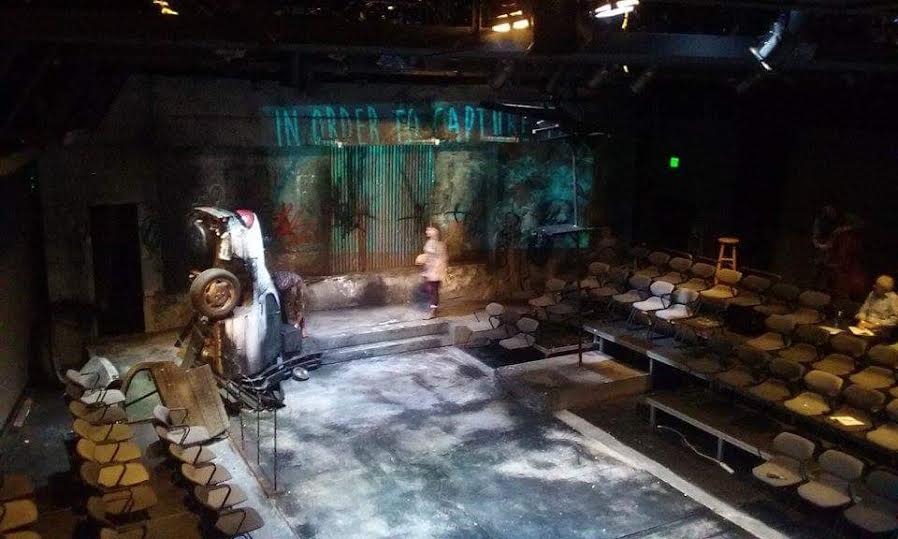
When Elai was in high school, she wrote a research paper on a possible career path that I  had wisely picked out for her. It was precisely this job, a technologist working with death rays or sound waves that travel ultra-ly through your tissues. It’s a great job. Good pay. You get to work in one white, windowless room for eight hours a day, helping very ill people in and out of a machine. “Right,” she said. “I get to look at what is hurting and killing people all day. In a room with no air. No thanks!” So much for my planning my daughter’s career path. She’s now a drama major at Wheaton, managing lights for a play called Caucasian Chalk Circle with half a car sticking up out of the stage. If I weren’t visiting Linac 1, 2, or 3, I could go see it with her. Sigh. The life of a starving artist, my dear. But so much more FUN!

But I tell you I am thankful for Dianne and Rob and Derek and Amanda who attend me, calling out those numbers, shifting, measuring, adjusting, syncing me to life. As they prep me, they say in their young voices, “Excellent. Perfect. Very good. I agree.” I feel part of a job well done. You can find satisfaction in any room. And compassion. And hosta leaves.

Really. Take Room. I haven’t seen the movie yet. It’s out this year. If you see it before I do, tell me what you think. The book was astonishing. It’s about Jack, born and growing up in one 10’ x 10’ room until he’s five because his mother is a captive there. To Jack, the room is an entire world because his mother makes it one, for love. “Good morning, Room,” he says. “Good morning, Lamp. Good morning, Sink.”

Hamlet, with such a different mother, cries out, “O God, I could be bounded in a nutshell and count myself a king of infinite space, were it not that I have bad dreams.” Do you know, it’s up to us to make the room livable? To call out, “Excellent?” To make a room a fairy tale with Sink and Brush for characters? To plant the hosta—on the ceiling if we have to?


Paul says, “I have learned to be content.”  God’s second greatest gift. After what makes it possible. Love. Am I ready for such a lesson?

Thursday, November 5, 2015

Familiar

I leave in another hour for my radiation treatment and a 30 second consultation with the radiologist, “No skin reaction? Great. See you next week.” or "It's just boring now, isn't it." He barely gets in the door. I wonder how a 30 second visit gets billed. Maybe it’s by the word. Fifty bucks a word would be about right. It’s clockwork now, no drama, no fuss. I don’t even have to register at the reception desk. I scan a bar code I’ve been given on a piece of paper, walk on back, change into a gown and sit down. I notice some of us get to stay in street clothes, and some of us have to wear patient uniforms, I mean gowns.  (I wonder if there were any women on the committee that designed them. They are so fashionable. And you have to remember which parts of you are covered and which aren’t, because it’s not obvious.) You don’t really notice the gowns so much when everyone is in uniform, the staff and the patients. But in mixed company, when half of the people in the waiting room look normal and you look like a pale blue blob wearing jeans and boots, you remember. But I am so used to it all now that when I lay under the machine and wait for the familiar series of beeps and buzzes, I almost fall asleep, and when the technicians come back in, I’m disoriented and forget to wait until they lower the bed, and I clunk my head against the machine. They apologize.

How quickly we get used to things. I have trains passing through my backyard every day, and I don’t hear them anymore. I remember when we lived in Ometepec, a group came down from North Carolina to visit us. They slept on the floor of our living room, right next to the street, under openings in the concrete to let in air…as well as the barking of the dogs that protected the street throughout the night. You know how they are. By day the just laze around, but by night the are filled with bravery. Glen couldn’t sleep with all that racket, so he opened the door and threw rocks at the dogs, and off they scurried (don't worry: you don’t have to hit Mexican dogs to get the message across. All you have to do is look like you are picking up a rock and winding up to throw, and that does the trick). But they’d always come back because they were just doing their job, protecting the street at night, and they had nowhere else to go. In the wee hours, Glen gave up and made his peace with the pack of dogs so that both of them could get some rest. We didn’t hear a thing. We were used to the noises of Ometepec.

I’m glad God made us able to get used to things so we can get some rest, but I’m even more glad that in the midst of repetitiveness, he surprises us, thumping us on the head. Today I looked outside, and at first I thought the window was dirty, but then I realized that in the few minutes since I’d last checked, the yard had been covered with mist, and I couldn’t see past the property line. I was encased in white water. This does not happen in Oaxaca City, and I am not used to it. I watch the trees dropping leaves, a steady rain of shimmering gold weaving a variegated rug on the ground. I have not seen this for fifteen years. In the radiation room I meet a new technician: Alexis. And Dianne, whom I’ve seen for three weeks now tells me I’m one of the fortunate ones to get this far in my treatments without redness. Someone else admires my new haircut (!) It’s easy to have a perfect haircut when you start out bald. Everything is so even.


Some things need to be boring and uneventful, like hospital visits and plane rides. I’m glad that in the midst of ordinary days, God sends extraordinary things, like fogs, and nurses who notice haircuts, and friends who sleep on floors. And if the things He makes (nurses, gold-raining trees) have endless ability to surprise and engage us, imagine living with God, Himself, the source of all surprise and personality. No wonder we will not need the sun to vary our days. We will work for an eternity to know God, and He will become Familiar, but we will never get used to Him. 


Tuesday, November 3, 2015

Relational muscles

As Robert and I drive around the Niagara region we see how the buildings reflect the changes in the culture since we lived here twenty years ago. I mentioned the rural churches I see closed down and put up for sale, but rural schools are being sold, too. The tiny school up the road from us now has just closed. It still has the painting on the outside walls of adults and children holding hands together. All different colors. Robert went to kindergarten there, and my friend Dawnelle used to go there only a few years ago. As the number of school kids enrolling each year continues to drop, the school boards close more local schools and build large, amalgamated ones, so if you’re interested in renovating a quaint old school as a home, now is the time. The median age here in the Niagara region is higher than elsewhere in Canada. There aren’t as many young people running around, so it’s just that much more homogeneous, maybe a bit more staid, more private.

At the same time, new homes keep going up. We see housing developments where there used to be fruit farms. And the size of custom homes is impressive. Every week, when we drove to Robert’s nephew’s farm to pick up our box of fresh vegetables in the summer, we looked across the street to see how the new house was coming along. Maybe it’s 10,000 square feet. I don’t know. It has two separate garages and two separate upper decks overlooking the lake, as well as two separate patios out the back sliding doors. It’s huge. Looks like a hotel. And it’s for two people. I’m not saying what the square footage for a couple should be; I’m just saying that even by this culture’s standards, the place stands out. That’s a lot of privacy.

Diego Rivera
And I think of Mixtec homes where we used to live. There is no word for privacy in their language. Their homes once used to be one room, sometimes two, with wooden walls and roof, for sleeping and for cooking. The smoke rose right through the wooden shakes. Then they built houses out of adobe, a little larger, and now the smoke found its way through tile roofs. Most recently, with money trickling back from relatives working in the US, the houses are concrete, but the same pattern applies, two rooms: one for sleeping and the other for everything else. Now gas stoves begin to replace the wood fires on the ground, and moms send their children to the mill down the street to grind their limestone-soaked corn kernels instead of crushing them at home on their kitchen grindstones, but I don’t yet see them building separate bedrooms and separate living spaces. Privacy is a commodity they cannot yet afford. Of course North American houses once looked more like that, too, many, many years ago.

It’s a paradox. As families in North America prosper, we choose to have less kids and roomier houses. We are busier and spend less time at home. It’s more and more difficult to have people drop by or stay for dinner, and there is no expectation that we should. We value our privacy and see it as a basic need. People’s lives overlap less and less as their society prospers, and convenience is more and more an option. This is a more comfortable way to live. Of course it is, and we all choose this way when we can. It eliminates all kinds of stress, and tension, and conflict. But it does not teach us as much as when we live overlapping lives. It does not demand as much, does not require as much sacrifice, does not show up our faults to be corrected, hopefully in love.

The Mixtec communities we visit are poor. To survive, families stick together and rely on each other a great deal. People traveling have very few options for lodging, so the culture values hospitality. When we show up on their doorstep unannounced, they take us in and give us room to sleep where everyone sleeps. They might give up their only bed, if they have one. Their space is our space. I remember when we were first married and living in a borrowed home, a two-room adobe place, the family sent their daughter to live with us so we wouldn’t be alone. When my Colombian friends were here, Girlesa told me about how she has spent months with a team of six missionary trainees living in her home with her. It’s been tough, but she knew it was the right thing to do. Six months? I couldn’t do this. I am more North American than Mixtec and realize how much I value privacy, control over my own space and time. It’s a gift that prosperity brings. But I also realize that Mixtecs have relational muscles I can’t even understand because their poverty has required a generosity never required of me. I honor that. The Kingdom of God is close to them. Their muscles bulge.


Monday, November 2, 2015

Day of the Dead

Yesterday I walked in a billion yellow maple leaves. They shuffled like feet beneath me as I walked, and the ground was a shifting mosaic, a working palette of yellow that made up for the dull grey sky. Threatening, they call it, that cloud-heavy ceiling weighted with water about to fall, once the clouds decide on the form—snow, sleet, hail, or just plain cold rain. We had an afternoon free after the day’s visit to the hospital, and we found the short hills (an oxymoron-that, but the best you can do in Ontario where “the mountain” is a 190 foot cliff made impressive not by height but by mighty waterfalls.) We wandered through the hills, finding leaves. On the drive back we noted the Halloween decorations in people’s yards, giant threatening figures made of black plastic, and giant threatening faces hacked into pumpkins.

In Oaxaca, my teammate Tiff has posted these photos of the Day of the Dead. It is the biggest holiday of the year. It spans 3 days, beginning the evening of October 31, and coincides with the three Catholic feast days All Saints’ Eve, All Saints’ Day, and All Souls’ Day, but it’s not Halloween. It’s a festival the Indians of southern Mexico celebrated for hundreds of years before the Catholic Church came to teach of Christ and to build its cathedrals on their holy sites. The Church moved the Day of the Dead from early August to November 1 to keep it within Catholic tradition. It’s hard to tell today who learned from whom in such moves.

If I were a Oaxacan Mixtec today, I wouldn’t be looking at leaves. I’d be cleaning and decorating the graves of loved ones with bright marigold flowers that represent the sun and building an altar in the living room with food my loved ones craved—tamales, atole, and the sweet bread of the dead. There’d be candy skulls with their names engraved across the forehead and candles, and I’d pull more gold flowers apart and lay a trail of petals to the door to light the way for my loved ones when they came at night to eat the essence of the food, and I and all my town would meet at the cemetery and wait for them there, and there would be musicians playing all night, and singing and partying, because the loved ones don’t come like the living dead but like good Mexicans, all glitter and sparkle and wide skirts, with huge smiles, ready for a party. And sure, there are chilling tales of what happens when people neglect the dead and forget to build the altars, but who wouldn’t be angry if you came up from the grave in your dancing clothes and you found your family in bed snoring?

One commemoration for the dead stands out for me. In a Mixtec town called Yuvinani, a man who had come to know Jesus and had pleaded publically with his town to come to Him was martyred. His name was John. A year later, his friends and family gathered early in the morning at his grave. They sang and prayed and reminisced about John’s life and sacrifice. But they were not waiting for him to come back on any Day of the Dead.  They knew well where he was and were glad for him.


 I am sure that on November first every bone in their bodies yearned to build that altar with all those marigolds and candles and food. It was the way they knew to show love. We have no idea what it takes to throw away a tradition that important. Imagine killing Christmas. Yet they did, because they now knew where their dead were going and how they would return, and this good news was the new axis of their lives. And yet, “the kingdom of God is a party,” so here’s the dilemma of missionaries. How do you redeem such rich and colorful traditions as building altars for the wandering dead? How could the truth of the resurrection unleash such creativity, such fellowship, and such joy in a Mixtec town that strolls, not over fallen yellow leaves, but over the strewn yellow petals of the sun?

Saturday, October 31, 2015

Sync

Sync.  It’s a term everyone uses now (in Oaxaca a sincronisada is a quesadilla with ham), but it’s relatively new.  It first appeared in written form in 1985, but its mother term was an invention of the Industrialization era, taken from the Greek word synkhronos, meaning at the same time, and used in 1879 to describe the synchronization of all those new timepieces that were the fad of the era.  One of the books I teach in Oaxaca is Around the World in Eighty Days by Jules Verne (1873). Phileas Fogg, a clock-like man in his punctuality and precision (he fires his valet for bringing his shaving water at 84° instead of 86°), takes on a wager worth about 1 ½ million that he can make it around the world in 80 days, using the newly built Suez Canal, the Transcontinental Railroad in the US, and the linking of the Indian railways. It’s a tribute to machines and a foreshadowing of global tourism. Fogg races against the clock and makes it back just in time, checking his pocket watch all the way, but he thinks he has lost the wager because he is out of sync—he has not taken into account the time changes.

My daughter is enchanted by the style that today echoes the Industrial era and especially its “scientific fiction”: the flying ships, the machine-driven houses. It’s called steam punk, and it relies often on alternative histories set in the Victorian era, in other words, stories that happen in sync, “at the same time.”

My friend Larry from Lively is a psychologist. After I mentioned about mirror neurons (how our emotions are so synced with our kids), he sent me this video clip: https://www.youtube.com/watch?v=apzXGEbZht0  where a baby and her mother communicate without words. You see the baby check with the mom over and over to validate her emotions, her take on things. And then for one whole minute, the mom clears her face of all emotion and doesn’t react at all, and after a few attempts to engage, the baby becomes distressed and starts crying. No one is listening. There is no one to sync with.

When I walk into the radiation lab, Rob, the technician, asks me about my weekend and exclaims that he’s from Sudbury, and asks did I like it there. He is trained (I assume) and willing to make small talk to help me sync my emotions to his, to calm myself before going into a machine with my chest exposed to fire.  I watch as he syncs me to the machine, adjusting its beam to the four tiny black tattoos on my chest, pulling on the sheet under me to align my body. He explains how the machine adjusts the beam according to what the radiologist says I need, closing its aperture and shooting four or five times, honing in on one spot.

And in the evening, I drive to the city to join 70 other people in rehearsing Christmas music (we will be holding the concert Nov 27/28. Please come!) And we sync our voices, the timing, the volume, the energy (chop/chop; punch/punch; glo-ho-ri-ous) so that we are one voice, celebrating. And I listen to my neighbors, and I watch the director (who is a chop/chop kind of guy) and I listen to myself, and I adjust and adjust. I learn. And it’s a good feeling. I wonder if it’s what God felt when he made the world good.


All of life has this one purpose. To sync not our wildly different ways of doing things but our wild wills for doing them. Because the first and greatest commandment is this: Love God with all your heart and all your mind and all your body. And the second is like the first: Love your neighbor as yourself. And when the new creation is complete, that precise City, that flying Mansion, that one Body with members finally synced to work at a million things with one mind, we will all see that it’s been hard, but it’s been good. No regrets. No "undo."